
Last updated: 07/2026
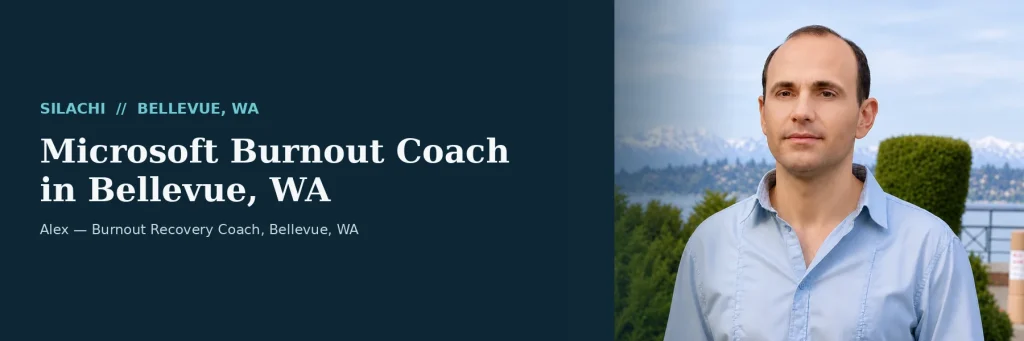
By Alex Akselrod, Certified Wellness Coach & Burnout Recovery Specialist
If you searched for a Microsoft burnout coach in Bellevue, chances are you already know something needs to change. Maybe it’s the dread that hits before you’ve even opened Outlook. Maybe it’s the growing distance between how you used to feel about your job and how you feel now. Whatever brought you here, you’re in the right place — and you’re closer to relief than it might feel like right now.
Based in Bellevue, WA — minutes from the Microsoft Redmond campus — Silachi works specifically with tech professionals navigating chronic work stress, exhaustion, and burnout. This isn’t generic wellness coaching. It’s a focused, local practice built around the specific pressures of working inside — or alongside — one of the world’s largest tech employers.
Why “Local” Matters When Choosing a Burnout Coach
You could find burnout coaches anywhere online. So why does it matter that your coach is based in Bellevue?
1. Shared context, less explaining. A coach working in the Eastside tech corridor already understands Connect cycles, Level bands, matrixed reporting lines, and the rhythm of a Microsoft fiscal year. You spend your sessions solving problems, not providing background.
2. Understanding of the local commute and lifestyle pressures. Whether you’re commuting from Bellevue, Kirkland, Redmond, or further out on 520 or I-90, the traffic, the housing costs, and the compressed personal time that comes with living in this region all factor into a realistic recovery plan — not a plan built for someone with an entirely different daily rhythm.
3. In-person or hybrid options. While many coaching relationships work well entirely over video, some clients recover faster with the option of an occasional in-person session — a walk-and-talk near Bellevue Downtown Park, or a coffee meeting instead of another video call added to an already Teams-heavy day.
4. Community familiarity. A Bellevue-based coach is more likely to already understand the broader Eastside tech ecosystem — including how burnout shows up differently for someone at Microsoft versus a nearby company — because the same patterns and pressures show up across the local tech workforce, not just at one employer.
Common Burnout Patterns Among Bellevue-Area Microsoft Employees
Working with tech professionals across the Eastside, a few recurring patterns show up again and again:
- The “always five minutes from Redmond” trap. Living close to campus can blur the line between “leaving work” and “actually being off,” since it’s just as easy to log back in after dinner as it is to relax.
- Compressed personal time. Long commutes for those coming from Seattle, Snoqualmie, or further out, combined with demanding roles, leave little buffer for recovery — so burnout compounds quietly over months, not days.
- Dual-income tech households. In many Bellevue-area households, both partners work demanding tech jobs, which means there’s often no “less busy” partner to absorb the slack when one person is overwhelmed.
- High cost-of-living pressure. The financial reality of the region means many professionals feel they can’t afford to slow down, even when they clearly need to — which often delays getting support until burnout is more severe.
- Identity fusion with the badge. For many, “I work at Microsoft” has become deeply tied to self-worth, making it especially hard to acknowledge burnout without it feeling like personal failure.
If any of these resonate, know that these patterns are common, well-documented, and — most importantly — addressable with the right support.
What Working with a Bellevue-Based Burnout Coach Looks Like
Step 1: A Confidential Discovery Conversation
Every engagement starts with an honest, no-pressure conversation about what’s going on — your role, your team dynamics, your workload, and what recovery would actually look like for you specifically. This isn’t a sales pitch; it’s a chance to see whether coaching is the right fit.
Step 2: A Personalized Burnout Assessment
Using structured frameworks informed by established burnout research — including the dimensions of exhaustion, cynicism, and reduced efficacy identified by the World Health Organization — we map exactly where your burnout is coming from, rather than treating it as one vague problem.
Step 3: A Practical, Calendar-Tested Recovery Plan
This is where local, in-person familiarity pays off. Your plan accounts for your actual commute, your actual team’s working hours, and the actual rhythm of your role — not generic advice about “unplugging” that ignores your reality.
Step 4: Weekly Coaching Sessions (In-Person or Virtual)
Sessions can happen via video for flexibility, or in person around Bellevue and the surrounding area for clients who prefer face-to-face connection. Many clients find alternating between the two works well — video for quick check-ins, in-person for deeper working sessions.
Step 5: Ongoing Recalibration
Your role, team, and workload will keep changing — a new manager, a reorg, a high-stakes launch. Coaching continues to adapt your systems as your circumstances shift, rather than treating recovery as a one-time fix.
Signs It’s Time to Reach Out to a Burnout Coach
- You’re succeeding on paper but feel completely disconnected from your work
- You’ve started resenting meetings, teammates, or projects you used to care about
- Your sleep, appetite, or patience have noticeably changed over the last several months
- You’ve quietly started browsing job listings out of a desire to escape, not genuine interest
- Weekends feel like recovery time rather than actual time off
- You suspect you’re burned out, but you’re not sure what to do about it — or who to tell
According to the American Psychological Association, chronic workplace stress that goes unaddressed doesn’t just affect performance — it has measurable effects on physical health and long-term wellbeing, which is why earlier intervention consistently leads to better outcomes than waiting until a crisis point.
Frequently Asked Questions
Do I need to work at Microsoft specifically to work with a Bellevue burnout coach? No. While much of the local client base works at Microsoft, coaching is equally relevant for professionals at other Eastside tech companies facing similar pressures — matrixed teams, high-visibility performance cycles, and always-on culture.
Is coaching confidential from my employer? Yes. Coaching is entirely separate from any internal HR or wellness program, and nothing discussed in sessions is shared with your employer.
Can we meet in person in Bellevue, or is everything virtual? Both options are available. Many clients start with virtual sessions for convenience and add occasional in-person meetings as their schedule allows.
How is this different from therapy? Coaching is forward-focused and centered on your relationship with work — redesigning your schedule, boundaries, and mindset around your job. It’s not a replacement for therapy, and if clinical symptoms like persistent depression or anxiety come up, we’ll discuss bringing in a licensed therapist alongside coaching.
How long does it typically take to feel a difference? Many clients notice initial relief within the first two to three weeks as urgent stressors are addressed, with deeper, more durable change unfolding over two to four months.
Start Your Recovery, Close to Home
You don’t have to keep pushing through exhaustion just because everyone around you seems to be doing the same. Burnout recovery is possible — and having a coach who understands both the pressures of working at Microsoft and the realities of living and working on the Eastside can make that recovery faster, more grounded, and easier to sustain.
Learn more about our approach on the services page, or read our companion guide on Burnout Recovery Coach for Microsoft Professionals for a deeper look at what a coaching engagement involves. For more Bellevue-specific reading, see Fast Burnout Recovery in Bellevue, Washington, Stress Management Bellevue: Your Essential Guide, and From Burned Out to Unstoppable: Burnout Recovery Guide for Tech Leaders in Bellevue WA.
Ready to talk? Schedule a free, confidential discovery call with a Bellevue-based burnout coach today, and take the first step toward getting your energy — and your life outside of work — back. You can also learn more about our founder on the About page.
Further reading: World Health Organization – Burn-out an “occupational phenomenon” | American Psychological Association – Coping with stress at work | Mayo Clinic – Job burnout: How to spot it and take action
About the Author
Alex Akselrod, Certified Wellness Coach and Burnout Recovery Specialist

Alex Akselrod is the founder of Silachi and a certified wellness and life coach based in Bellevue, WA, with 15 years of experience helping clients overcome burnout, chronic stress, and low energy using the integrative Silachi Method. A Qigong teacher, Advanced ThetaHealer®, and published author of Restore Your Health in 30 Days or Less, Alex has worked with hundreds of high-performing tech professionals — including many at Microsoft — to help them rebuild sustainable, energized careers.