
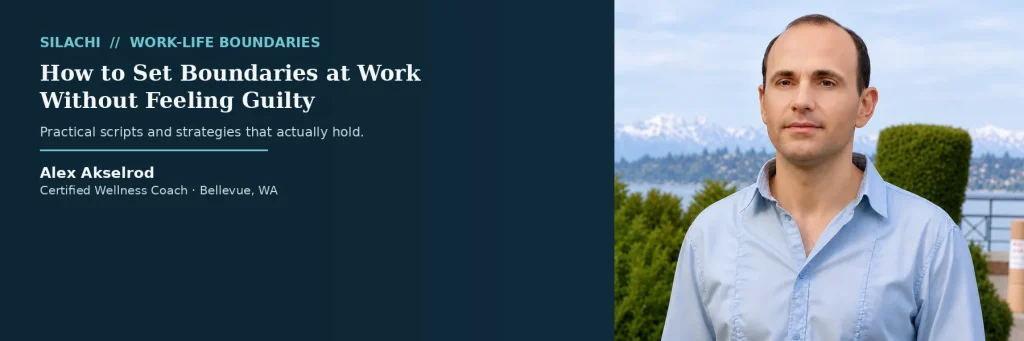
Last updated: 08/2026 By Alex Akselrod, Certified Wellness Coach & Burnout Recovery Specialist
You know you should say no to the extra project. You know answering emails at 9pm isn’t sustainable. You know your calendar has no white space left. And yet, when the moment actually comes to set a boundary — to decline, to log off, to say “that’s not something I can take on right now” — guilt shows up before the words do. If this pattern feels familiar, you’re far from alone, and the good news is that the guilt itself is workable, not just something you have to push through indefinitely to ever have boundaries at all.
Why Boundaries Feel So Uncomfortable in the First Place
Boundary-setting discomfort isn’t a personal flaw — it’s a fairly predictable response, especially in high-performance professional cultures like Bellevue’s dense tech industry. A few dynamics tend to drive it:
High-achievers often equate their worth with their output. If a significant part of your identity is built around being reliable, capable, and always delivering, saying no can feel like it threatens something more fundamental than just your schedule — it can feel like it threatens your sense of who you are.
Always-on culture has normalized boundary-free availability. In many tech workplaces, responding immediately to a late-night Slack message has quietly become the unspoken norm, which makes anyone who doesn’t do so feel like they’re breaking an unwritten rule, even if no explicit rule actually exists.
Fear of being seen as difficult or not a team player. Especially in competitive, high-visibility roles, there’s often a real (or perceived) risk that setting limits will be read as lack of commitment, which can feel particularly loaded during review cycles, reorganizations, or periods of job insecurity.
Past experiences of boundaries not being respected. If previous attempts to set limits were met with pushback, guilt-tripping, or simply ignored, it’s natural to associate boundary-setting itself with conflict or disappointment, even in a new or different context.
The Real Cost of Not Setting Boundaries
It’s worth being direct about what happens when boundaries consistently don’t get set, since the discomfort of setting them is often weighed against an underestimated cost of not doing so.
Chronic boundarylessness at work is one of the most reliable paths to burnout. The World Health Organization’s classification of burnout describes it as resulting from chronic workplace stress that hasn’t been successfully managed — and an inability to set limits on your time, energy, and availability is one of the most direct paths to exactly that kind of chronic, unmanaged stress. Beyond burnout specifically, a lack of boundaries tends to compound over time: today’s “just this once” often becomes tomorrow’s default expectation, making each subsequent boundary harder to establish than the last.
There’s also a less obvious cost: work without boundaries often produces lower-quality output, not just more exhausted output. Sustained overextension degrades focus, creativity, and decision-making — meaning the very reliability and quality you’re trying to protect by saying yes to everything often erodes as a direct result of never saying no.
Understanding the Guilt Itself
Guilt around boundary-setting typically isn’t really about the boundary — it’s about an underlying belief that needs examining directly. A few common ones worth recognizing:
“If I say no, I’ll be letting people down.” This often overestimates both the actual impact of a single boundary and underestimates other people’s capacity to adjust or find alternative solutions.
“Good employees don’t set limits.” This belief tends to conflate constant availability with genuine competence and reliability — two things that are actually distinct, and that a boundary-setting employee can absolutely still embody.
“If I don’t do it, no one will, or it won’t get done right.” This is often less true than it feels in the moment, and even where it contains some truth, it’s worth asking whether it’s sustainable — or fair — for that responsibility to rest entirely on you indefinitely.
“Setting boundaries makes me selfish.” This reframes a legitimate act of self-preservation as a moral failing, which tends to make boundary-setting feel far heavier than it needs to.
Recognizing which of these underlying beliefs is driving your specific guilt is often the first meaningful step toward loosening its grip — the guilt tends to lose some of its intensity once you can name the actual belief behind it, rather than experiencing it as a vague, unexamined discomfort.
A Practical Framework for Setting Boundaries
1. Get Specific About What You Actually Need
Vague intentions like “I need better work-life balance” are hard to act on. Specific boundaries — “I don’t check email after 7pm,” “I need 48 hours’ notice for new requests when possible,” “I take my full lunch break” — are far easier to hold consistently, since they’re concrete enough to actually follow through on rather than reassess in the moment every time.
2. Separate the Boundary From an Apology
Many people instinctively over-explain or over-apologize when setting a boundary, which often signals uncertainty and can invite pushback. Compare “I’m so sorry, I know this is probably really inconvenient, but I don’t think I can take this on right now, I’m really sorry” with a simpler “I’m not able to take this on right now — my plate is full through Friday.” The second version is clearer, more confident, and paradoxically often received better, since ambiguity tends to invite negotiation in a way clarity doesn’t.
3. Offer an Alternative When You Can, but Don’t Feel Obligated To
Offering an alternative — a different timeline, pointing to someone else, a partial yes — can soften a boundary without undermining it. That said, it’s not a requirement. A boundary is complete on its own; an alternative is a courtesy, not an obligation you owe every time.
4. Expect Some Initial Discomfort, and Let It Pass Without Reacting to It
The guilt or awkwardness immediately after setting a boundary is often at its most intense in that first moment — and tends to fade faster than anticipated, especially once you have a track record of a few boundaries that didn’t actually produce the catastrophic reaction you feared.
5. Start With Lower-Stakes Boundaries
If boundary-setting feels significantly uncomfortable, it’s often more sustainable to build the skill gradually with smaller, lower-stakes boundaries before tackling the highest-stakes ones — declining a lower-priority meeting before renegotiating your entire workload with a manager, for instance.
Boundary Scripts for Common Work Situations
Having language ready in advance tends to reduce the in-the-moment guilt significantly, since you’re not improvising under pressure.
Declining additional work when you’re at capacity: “I want to give this the attention it deserves, and I don’t have the bandwidth to do that well right now given my current workload. Can we talk about priorities, or revisit timing?”
Setting after-hours availability limits: “I’m generally offline after [time] to be present with my family/recharge, but I’ll pick this up first thing in the morning.”
Pushing back on scope creep: “This has grown beyond what we originally scoped. I’m glad to take it on, but we should talk about adjusting the timeline or resourcing to match.”
Protecting focus time: “I’ve got heads-down time blocked this afternoon to finish [project] — can we find another slot, or is this something that can wait until tomorrow?”
Responding to a guilt-inducing reaction from someone else: “I understand this is frustrating, and I still need to hold this boundary. Let’s figure out a solution that works within it.”
Boundaries With a Manager Specifically
Setting boundaries with a direct manager can feel especially high-stakes, given real or perceived career implications. A few things worth keeping in mind specifically for this context:
Frame it around sustainability and output quality, not just personal preference. Managers are often more receptive to boundaries framed as protecting the quality and consistency of your work over time, rather than framed purely as a personal need — even though both are legitimate, this framing tends to land better in a professional context.
Bring it up proactively, not just reactively in the middle of a crisis. A boundary conversation initiated calmly, outside of an acute deadline crunch, tends to go better than one raised defensively in the heat of an overwhelming moment.
Document patterns, not just single incidents. If workload has been consistently unsustainable, having a clear sense of the pattern — not just the most recent instance — makes for a more compelling and specific conversation than a vague, in-the-moment complaint.
If a boundary conversation with your manager feels like it needs deeper preparation, particularly if burnout is already significantly affecting you, our guide to how AI-driven anxiety about job security intersects with workplace stress covers some of the specific fears that can make this conversation feel especially fraught right now.
Why Boundaries Actually Improve Relationships, Not Just Protect You
It’s a common misconception that boundaries are purely self-protective and come at some cost to relationships or team dynamics. In practice, the opposite is often true. Clear boundaries tend to:
Reduce resentment before it builds. Chronic over-extension without boundaries frequently produces quiet resentment toward colleagues, managers, or the organization — resentment that boundary-setting, done early and clearly, tends to prevent from accumulating in the first place.
Make your yeses more meaningful. When you say yes to everything by default, a yes carries little information. When you have real boundaries, your yes signals genuine capacity and commitment, which colleagues and managers often come to trust and value more over time.
Model healthier norms for others. In teams where no one sets boundaries, unsustainable patterns tend to compound across everyone. Someone modeling clear, respectful boundaries can create space for others to do the same — this dynamic is explored in more depth in our guide for managers supporting a burned-out team, which covers this from the leadership side.
Boundaries at Work and Their Ripple Effect at Home
Work boundaries rarely stay contained to work. Chronic overextension at the office consistently bleeds into personal relationships — reduced patience, less presence, less energy left over for partners, family, and friends. If work boundaries have been particularly difficult to hold and it’s beginning to show up in your relationship specifically, couples-focused coaching can help address both the work pattern and its relational impact together, rather than treating them as entirely separate problems.
When Guilt Persists Despite Doing “Everything Right”
Sometimes, even with clear language, reasonable framing, and low-stakes practice, the guilt doesn’t meaningfully diminish. When this happens, it’s often a sign that something deeper than a specific work situation is at play — a longer-standing pattern around self-worth, approval-seeking, or difficulty tolerating others’ disappointment, which may benefit from more structured support than boundary scripts alone can address. This is where working through the underlying pattern, not just the surface behavior, tends to matter — an approach central to the Silachi Method, which addresses root-level patterns rather than only situational coping strategies.
Common Boundary-Setting Mistakes That Backfire
A few patterns tend to undermine boundaries even when the underlying intention is sound:
Setting a boundary but not holding it consistently. A boundary that gets enforced sometimes and waived other times tends to communicate that it’s negotiable, which often makes it harder to hold the next time, not easier. Consistency, even imperfect consistency, tends to matter more than any single instance of holding firm.
Over-explaining or justifying excessively. As covered earlier, lengthy justification often signals uncertainty rather than confidence, which can invite negotiation or pushback that a simpler, clearer statement wouldn’t have.
Waiting until you’re at a breaking point to set any boundaries at all. Boundaries set from a place of acute overwhelm or resentment often come across as reactive or even hostile, compared to boundaries established proactively and calmly, before frustration has fully built up.
Assuming a single boundary conversation will fix an entrenched pattern. Particularly with long-standing workplace dynamics, one conversation is often the beginning of a shift rather than a complete, permanent fix — expecting instant, total resolution can lead to discouragement and abandoning the effort prematurely.
Setting boundaries only around work, while ignoring their absence everywhere else. Boundaries tend to be interconnected — someone who struggles to say no at work often struggles similarly in personal relationships, and vice versa. Addressing the pattern more broadly, rather than treating it as purely a workplace issue, often produces more durable change.
How Boundary-Setting Connects to Broader Burnout Prevention
Boundaries aren’t just a standalone skill — they’re one of the most direct, practical levers available for preventing burnout before it becomes chronic. If you’re already noticing some of the early markers of burnout — persistent exhaustion, growing cynicism about work, a sense that your effectiveness is slipping — boundary-setting alone may not be sufficient, though it remains an important piece of a broader response. In that case, it’s worth reading more about the fuller burnout recovery process for busy tech professionals, since boundaries work best as one part of a more comprehensive approach once burnout has already taken hold, rather than a standalone fix at that later stage.
For those specifically navigating the intensity of roles at major Bellevue-area employers, boundary-setting often needs to account for a workplace culture that may not naturally support it — our guide on burnout recovery specifically for Microsoft and Google professionals addresses some of these industry-specific dynamics in more depth, including how to navigate boundary-setting within a culture where it isn’t always the norm.
A Different Way to Think About the Guilt
One reframe that many clients find genuinely helpful: guilt is often a signal that you’re doing something unfamiliar, not necessarily a signal that you’re doing something wrong. Almost any meaningful behavior change — including healthy ones — tends to produce some initial internal resistance simply because it’s new and breaks an established pattern, whether that pattern was ever actually serving you or not.
Approached this way, the guilt itself can become useful information rather than a stop sign: its presence often indicates you’re doing something different than your usual pattern, which is frequently exactly the point. Over time, as new boundaries become part of your normal way of operating, the guilt that once accompanied them typically fades substantially, replaced by boundaries that feel less like an act of defiance and more like simply how you operate.
Frequently Asked Questions
What if setting a boundary genuinely does upset someone? Some initial friction is a realistic possibility, not a sign you’ve done something wrong. A reasonable, respectfully communicated boundary that upsets someone is more often a reflection of their expectations needing to adjust than evidence the boundary itself was inappropriate.
How do I set boundaries without seeming uncommitted to my job? Framing boundaries around sustainability, focus, and long-term output quality — rather than as a personal limitation — tends to communicate commitment rather than undermine it. Consistently high-quality, sustainable work over time is generally a stronger signal of commitment than short-term, boundaryless availability.
Is it normal to still feel guilty even after successfully setting a boundary? Yes, especially at first. Guilt often persists for a while even when a boundary was appropriate and well-communicated — it tends to fade with repetition and evidence that the anticipated negative consequences didn’t materialize.
What if my workplace culture genuinely doesn’t support boundaries? This is worth taking seriously rather than assuming the problem is purely personal. If a workplace consistently and explicitly punishes reasonable boundaries, that’s a meaningful signal about organizational culture, worth factoring into broader career decisions, not just something to personally push through indefinitely.
How do I set boundaries with a manager without risking my career? Framing the conversation around sustainability and quality, choosing a calm rather than reactive moment, and bringing concrete patterns rather than vague complaints all tend to reduce risk significantly, though no approach eliminates all risk in every workplace culture.
Can therapy or coaching help if boundary guilt feels disproportionately intense? Yes — if guilt around reasonable boundaries feels persistently overwhelming despite genuine effort, that’s often worth exploring with a coach or therapist, since it may point to a deeper pattern around self-worth or approval-seeking that benefits from more structured support than boundary scripts alone provide.
Ready to Build Sustainable Boundaries?
If guilt has been quietly preventing you from protecting your time and energy at work, addressing the underlying pattern — not just memorizing better scripts — tends to produce more lasting change.
Learn more about the Silachi Method, explore Alex Akselrod’s approach and background, or schedule a free consultation to talk through what’s making boundaries feel so difficult in your specific situation. Questions before then? Reach out through the contact page.
Further reading: World Health Organization – Burn-out an “occupational phenomenon” | American Psychological Association
About the Author

Alex Akselrod is the founder of Silachi and a certified wellness coach based in Bellevue, WA, with 15 years of experience helping clients set sustainable boundaries, recover from burnout, and build lasting wellbeing using the integrative Silachi Method. A Qigong teacher and Advanced ThetaHealer®, Alex works with individuals and couples across the Eastside to help them restore energy and create lasting, meaningful change.