
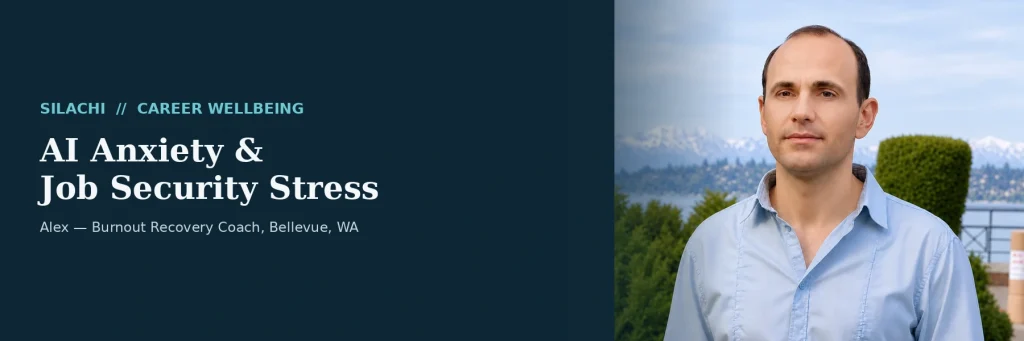
Last updated: 07/2026 By Alex Akselrod, Certified Wellness Coach & Burnout Recovery Specialist
If the constant drumbeat of AI headlines — layoffs, “AI-first” reorgs, Copilot rollouts replacing entire workflows — has left you feeling unsettled about your own job, you’re far from alone. What used to be background noise for most tech professionals has become a persistent, low-grade hum of dread for many: Is my role next? Am I still valuable if a model can do half of what I do?
This feeling has a name now — AI anxiety — and it’s becoming one of the most common sources of workplace stress we see in our Bellevue practice, particularly among clients at Microsoft, Amazon, and other Puget Sound tech employers navigating rapid AI adoption.
What Is AI Anxiety, Exactly?
AI anxiety refers to the chronic worry, uncertainty, and identity threat many workers feel in response to artificial intelligence reshaping their industry — distinct from garden-variety job stress because it targets something deeper: your sense of professional competence and irreplaceability. It’s not simply “will I get laid off this quarter.” It’s a quieter, more corrosive question: does what I know how to do still matter?
Recent data confirms this isn’t an isolated feeling. A large-scale 2026 tech worker sentiment survey found the industry has effectively split in two — roughly half of tech workers report feeling amplified and energized by AI, while the other half feel shaken and less certain of their professional value. Among researchers specifically, over half reported feeling anxious about job security, and the same survey found burnout scores jumped sharply in a single year. Separately, workplace analytics from Glassdoor found mentions of AI anxiety in employee reviews rose sharply in 2026, alongside a measurable decline in trust toward leadership.
Why This Moment Feels Different From Past Waves of Change
Tech workers have lived through plenty of disruption before — cloud migration, mobile-first pivots, the shift to remote work. So why does AI-driven change feel so much heavier?
1. The pace is faster than anything before it. Previous technology shifts unfolded over years; AI capability is visibly changing month to month, which leaves little time for the nervous system to adapt before the next update arrives.
2. It targets cognitive work, not just manual tasks. Earlier automation waves mostly affected physical or repetitive labor. This wave targets writing, coding, analysis, and design — the very skills many knowledge workers built entire identities and careers around.
3. The messaging from employers is often mixed or absent. Recent workforce surveys have found a large share of employees say their employer has provided little to no formal guidance on how AI will affect their role, leaving people to fill in the uncertainty with their own worst-case assumptions.
4. It’s genuinely uncertain, not irrationally feared. The World Economic Forum’s Future of Jobs Report projects that by 2030, roughly 92 million existing jobs will be displaced by AI and other technological shifts, even as 170 million new roles are created — a net positive for the labor market overall, but a real, disruptive churn for individual careers along the way. Knowing the aggregate numbers work out doesn’t make it easier to sit with not knowing which side of that churn your own role will land on.
How AI Anxiety Shows Up in the Body — Not Just the Mind
Because AI anxiety is fundamentally about uncertainty and perceived threat to your competence and security, it activates the same physiological stress response as more immediate dangers — even though there’s no single moment of crisis to point to. Common patterns we see in coaching sessions include:
- Compulsively checking AI and industry news, even when it makes you feel worse
- Difficulty focusing on current work because part of your attention is on “what’s coming”
- A creeping sense of imposter syndrome, even in a role you’ve excelled in for years
- Overworking or over-functioning in an attempt to “prove your irreplaceability,” which often accelerates burnout rather than preventing job loss
- Avoidance — putting off learning new AI tools out of a mix of resentment and fear, which can ironically increase risk over time
- Sleep disruption, tension, and a persistent background sense of dread that doesn’t have an obvious single trigger
If several of these sound familiar, it’s worth recognizing that this is a real, physiological stress response — not a personal or professional failing.
A Grounded, Practical Approach to Managing AI Anxiety
1. Separate the Uncertain From the Unknowable
Much of AI anxiety comes from trying to predict something inherently unpredictable — exactly how and when your specific role will change. Rather than trying to forecast the unknowable, it helps to focus energy on what’s actually within your control: your current skill development, your professional relationships, and your financial cushion.
2. Build AI Fluency, Even Imperfectly
Workforce data consistently shows that employees who engage directly with AI tools — rather than avoiding them out of resentment or fear — report feeling more confident about their career trajectory than those who disengage. You don’t need to become an AI expert overnight; even basic, hands-on familiarity with the tools reshaping your field measurably reduces the sense of helplessness that fuels anxiety.
3. Regulate Your Nervous System Before Trying to “Think Your Way Out”
Because AI anxiety lives in the body as much as the mind, cognitive reassurance alone (“the data says it’ll be fine”) often isn’t enough to calm the physiological stress response. Practices like breathwork, Qigong, and other nervous-system-regulation techniques can help shift your body out of a chronic low-grade fight-or-flight state, making it easier to think clearly and make grounded career decisions rather than reactive, fear-driven ones.
4. Protect Your Identity Outside of Your Job Title
Part of what makes AI anxiety so destabilizing is how tightly many tech professionals’ sense of self is fused with their specific technical skill set. Rebuilding a broader sense of identity and worth — one that isn’t solely dependent on being the fastest coder or best analyst in the room — creates real psychological resilience against whatever comes next in your industry.
5. Have the Conversation With Your Manager, Even If It’s Uncomfortable
Silence from leadership is a major driver of AI anxiety. If your organization hasn’t clearly communicated how AI fits into your team’s roadmap, initiating that conversation yourself — framed around growth and adaptation rather than fear — often reduces uncertainty more effectively than waiting for a company-wide announcement that may never come.
When AI Anxiety Overlaps With Burnout
For many of our Bellevue and greater Seattle clients, AI anxiety doesn’t show up on its own — it layers on top of existing burnout from long hours, high-visibility performance cycles, and an always-on culture. The two feed each other: burnout depletes the mental and emotional reserves you’d otherwise use to adapt calmly to change, while AI-driven uncertainty adds a new, chronic stressor on top of an already-strained nervous system.
If you’re noticing both — exhaustion and a persistent undercurrent of professional dread — it’s worth addressing them together rather than treating AI anxiety as a separate, standalone problem. Our burnout recovery statistics guide and nervous system regulation guide go deeper into how these patterns show up specifically for tech professionals in high-pressure environments.
How Coaching Helps With AI-Era Career Stress
At Silachi, we work with tech professionals across Bellevue, Redmond, and the greater Seattle area using the Silachi Method — an integrative approach that combines practical coaching with nervous-system-focused practices like Qigong and breathwork. When it comes to AI and job security stress specifically, that looks like:
- Helping you build a grounded, realistic view of your own risk and opportunity, rather than one shaped entirely by algorithm-driven news anxiety
- Nervous system regulation techniques to reduce the chronic stress response so you can think clearly about upskilling and career decisions
- Identity work that helps decouple your sense of self-worth from a single job title or technical skill set
- Practical strategies for having honest conversations with managers and leadership about role evolution
Executives and senior leaders navigating team-wide AI transitions — not just their own personal uncertainty — may also benefit from our executive coaching program, built for those responsible for both managing their own stress and communicating change to others.
Frequently Asked Questions
Is AI anxiety a real, recognized problem, or just general job stress with a new label? While AI anxiety isn’t a clinical diagnosis, it’s a well-documented and increasingly common workplace phenomenon, distinct from general job stress in that it centers on identity and long-term relevance rather than just short-term performance pressure.
Should I avoid using AI tools if they make me anxious? Generally, no. Data suggests employees who engage directly with AI tools tend to feel more confident about their career prospects than those who avoid them, even though the initial discomfort of learning something new can feel counterintuitive in the moment.
Can coaching actually help with something as big and structural as AI-driven job displacement? Coaching can’t change macroeconomic or industry-wide trends, but it can meaningfully change how your nervous system and mindset respond to that uncertainty — which directly affects your ability to make clear-headed career decisions, sleep well, and avoid burnout while navigating a genuinely uncertain period.
How is this different from general burnout coaching? AI anxiety often overlaps with burnout but has its own distinct driver — uncertainty about long-term relevance rather than simply overwork. Coaching typically addresses both together, since they tend to compound one another in high-pressure tech environments.
What if my company hasn’t said anything about how AI will affect my role? This is extremely common — recent workforce data shows a large share of employees report receiving little to no formal guidance from their employer on this exact question. Rather than waiting, proactively building your own AI fluency and having a direct conversation with your manager are usually more effective than waiting for top-down clarity that may not arrive on your timeline.
You Don’t Have to Navigate This Uncertainty Alone
AI-driven job security stress is a legitimate, physiologically real response to a genuinely uncertain moment in the tech industry — not a sign of personal weakness or an overreaction. Whether you’re feeling it as background dread, active burnout, or both, support is available.
Learn more about our approach on the services page, read more on our blog, or schedule a free consultation to talk through what you’re experiencing. You can also reach out directly through our contact page.
Further reading: World Economic Forum – Future of Jobs Report 2025 | Lenny’s Newsletter – How Tech Workers Are Feeling in 2026 | American Psychological Association – Coping with Stress at Work | Stress Management in Bellevue: The Fast Track to Letting Go of Stress and Burnout
About the Author

Alex Akselrod is the founder of Silachi and a certified wellness and life coach based in Bellevue, WA, with 15 years of experience helping clients overcome burnout, chronic stress, and career uncertainty using the integrative Silachi Method. A Qigong teacher, Advanced ThetaHealer®, and published author of Restore Your Health in 30 Days or Less, Alex works closely with tech professionals across the Eastside — including many navigating AI-driven change at Microsoft, Amazon, and beyond.