
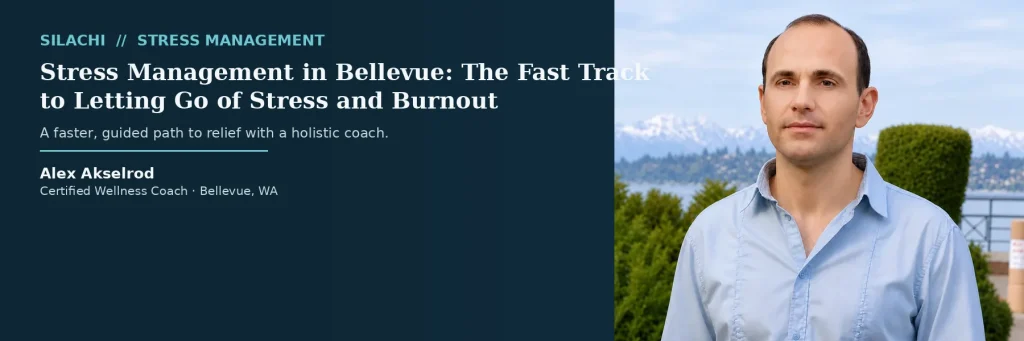
Last updated: 08/2026 By Alex Akselrod, Certified Wellness Coach & Burnout Recovery Specialist
If you’re searching for stress management in Bellevue, chances are you’re not looking for another article telling you to breathe deeply and drink more water — you’re looking for a real, structured way out of a state you’ve likely been stuck in for months, maybe years. This guide covers what actually drives chronic stress in Bellevue’s high-pressure professional environment, why generic stress management advice often falls short, and how a focused, accelerated coaching process can get you measurable relief faster than trying to piece it together alone.
Why Bellevue Has a Distinct Stress Problem
Bellevue isn’t an average American city when it comes to occupational stress. It sits at the center of the Eastside tech corridor, home to major Microsoft, Google, and Amazon offices, and a dense concentration of high-performing, high-pressure roles. The American Psychological Association’s annual Stress in America survey has repeatedly found that work is one of the top reported sources of chronic stress nationally — and that pattern shows up even more sharply in tech-heavy metro areas, where always-on communication culture, aggressive deadlines, and constant reorganization have become the norm rather than the exception.
If you work in or near Bellevue’s tech industry, there’s a good chance your stress isn’t a personal failing or a sign you can’t handle pressure — it’s a predictable response to a genuinely demanding environment. That distinction matters, because it changes the solution. Generic stress management tips assume you’re dealing with ordinary life stress; what many Bellevue professionals are actually dealing with is closer to chronic, occupational burnout, which the World Health Organization formally classifies as an occupational phenomenon resulting specifically from chronic workplace stress that has not been successfully managed.
Why Generic Stress Management Advice Often Doesn’t Work
Most stress management content online repeats the same handful of tips: exercise more, sleep better, try meditation, take breaks. None of this is wrong, exactly — but it’s incomplete, and for people already deep in chronic stress or burnout, it can actually be counterproductive. Being told to “just meditate more” when you can’t find fifteen uninterrupted minutes in your day isn’t help — it’s another item on an already unmanageable list.
There are a few specific reasons generic advice tends to fail for the kind of stress Bellevue professionals experience:
It treats stress as an individual willpower problem, not a systemic one. If your stress is being generated continuously by an unsustainable workload, no amount of personal optimization fully offsets that input. The National Center for Complementary and Integrative Health notes that effective stress management typically requires addressing both the internal response to stress and, where possible, the external sources generating it — not just coping mechanisms layered on top of an unchanged situation.
It offers isolated techniques instead of a structured process. A breathing exercise here, a productivity hack there — without a coherent plan connecting them, most people either don’t stick with any single technique long enough to see results, or end up more overwhelmed managing the stress-management routine itself.
It ignores the compounding, cumulative nature of chronic stress. Stress that’s been building for months or years doesn’t resolve with a single weekend of self-care. It typically needs a structured, sequenced approach — stabilizing first, then addressing root patterns, then building resilience — which is very different from a list of standalone tips.
What a Faster Path to Relief Actually Looks Like
This is where a focused, guided process — rather than self-directed trial and error — makes the biggest difference. At Silachi, this accelerated approach is built into the Breakthrough Session, designed specifically for people who are in an acute, high-stress state and need meaningful relief faster than a slow, generalized wellness routine can typically provide.
Rather than spreading effort across a long list of disconnected stress-management tips, the Breakthrough Session concentrates a single, intensive, guided experience around your specific stress patterns — combining focused coaching conversation with body-based techniques like breathwork and energy work to interrupt the stress response directly, rather than simply talking around it. Many clients report a noticeable shift in how they feel by the end of a single session, though how long that relief holds and how deep the underlying change goes typically depends on continuing into a fuller program afterward.
It’s worth being direct about what “fast” actually means here: this isn’t a claim that chronic stress or burnout disappears permanently in one sitting. It means you don’t have to wait months of scattered self-help efforts before experiencing real, felt relief — the process is designed to create momentum quickly, then build sustainable change from there.
How the Fast-Track Process Works, Step by Step
Step 1: A Focused Intake Conversation
Rather than a broad, unstructured discussion, the process starts by quickly identifying what’s actually driving your stress right now — a specific work situation, an accumulation of unaddressed pressure, a life transition colliding with an already full plate. This focused approach is part of what makes the session efficient rather than meandering.
Step 2: An Energy and Stress Assessment
Using the same assessment framework built into the Silachi Method, the session identifies where stress is showing up most acutely — physically, mentally, or energetically — so the session’s techniques can be targeted rather than generic.
Step 3: Active Intervention, Not Just Conversation
This is the core of what makes the Breakthrough Session different from typical talk-based stress management: it includes guided breathwork and mindful movement and energy-based techniques designed to shift your nervous system’s stress response in real time, during the session itself — not homework to try later.
Step 4: A Clear Next-Step Plan
You leave with a concrete sense of what continuing support would look like, whether that’s an ongoing coaching program like the Peace & Vitality Formula outlined on the services page, or, for burnout specifically tied to your career, the more structured burnout recovery blueprint.
Who the Fast-Track Approach Is Best Suited For
An intensive, accelerated session isn’t necessarily the right starting point for everyone. It tends to work best for:
- Professionals in an acute high-stress period — a demanding launch, a major deadline, a stretch of sustained overwork — who need relief now, not in three months
- People who’ve already tried generic self-help stress management without meaningful results and want a more structured, guided approach instead
- Tech and corporate professionals in Bellevue whose stress is closely tied to work intensity, where Microsoft and Google-specific burnout patterns are common
- Anyone who responds better to an active, embodied process — breathwork, movement, energy work — than to conversation alone
It may be less suited to situations involving diagnosable clinical anxiety, depression, or trauma requiring licensed mental health treatment — in those cases, coaching works best alongside, not instead of, professional therapeutic care.
The Difference Between Fast Relief and Lasting Change
It’s worth being clear-eyed about the difference between immediate relief and durable change, since conflating the two sets up unrealistic expectations either way.
Fast relief addresses the acute stress response — the racing thoughts, physical tension, and overwhelm that make it hard to function day to day. This is what a single focused session is designed to interrupt.
Lasting change addresses the underlying patterns that keep regenerating stress in the first place — unsustainable work habits, difficulty setting boundaries, a nervous system that’s been in a chronic stress state for so long it struggles to downshift even when the external pressure eases. This typically requires an ongoing structured program, not a single session, however effective that first session feels.
The fast-track approach isn’t meant to replace that longer process — it’s meant to give you real, felt momentum quickly enough that continuing into deeper work feels achievable rather than like starting from zero exhaustion.
Stress Management Techniques You Can Start Today
While a guided program accelerates results, there are a few evidence-informed practices worth starting immediately, based on guidance from the Mayo Clinic’s stress management resources and the American Psychological Association:
- Protect a hard stop to your workday, even fifteen minutes earlier than usual — an artificial boundary is better than none, and gives your nervous system a consistent daily cue to downshift
- Use brief breathwork between meetings rather than saving stress relief for the end of the day, when the cumulative load is already high
- Track your stress triggers for one week without trying to fix anything yet — simply noticing patterns is often the first useful step toward addressing them
- Limit constant context-switching where possible, since research consistently links task-switching to elevated perceived stress, independent of total workload
- Get outside briefly, daily, even in Bellevue’s grayer months — brief outdoor exposure is one of the more consistently supported low-effort stress interventions
These aren’t a substitute for structured support if your stress is chronic or severe, but they’re a reasonable starting point while you decide whether a more intensive process makes sense for you.
The Science Behind Why Fast, Active Intervention Works
It’s worth understanding briefly why active, body-based techniques tend to produce faster relief than conversation-only approaches, since this is really the mechanism behind the “fast track” framing.
Chronic stress isn’t purely a cognitive experience — it’s a physiological state, driven largely by a nervous system stuck in sustained activation. The American Institute of Stress and related physiological research describes how prolonged stress keeps the body’s sympathetic nervous system — the “fight or flight” response — engaged well beyond what’s useful, which is part of why purely cognitive strategies like reframing your thoughts often aren’t enough on their own to produce a felt sense of relief.
Breathwork, in particular, has a fairly direct physiological mechanism: slow, controlled breathing patterns activate the parasympathetic nervous system, the body’s counterbalancing “rest and digest” state, which is why many people notice a tangible shift in how they feel within minutes of a guided breathing session — not weeks. Combining this kind of active physiological intervention with a structured coaching conversation is part of what allows a single concentrated session to produce faster, more noticeable results than talk-based approaches alone, even though both are valuable, and even though lasting change generally still requires ongoing work.
This is also why generic “just relax” advice tends to fail — telling someone to relax doesn’t actually engage the physiological mechanism required to shift out of a stress response. A guided, active process is what closes that gap.
What Bellevue Clients Commonly Experience Immediately Before Seeking Help
Understanding the specific patterns that typically precede someone searching for stress management support can help you recognize where you stand, and how urgently a more structured approach might serve you. Common patterns among Bellevue professionals reaching out include:
A sustained period of “just getting through it.” Rather than a single acute crisis, many clients describe months of pushing through mounting stress by sheer willpower, often without recognizing how depleted they’d become until energy or motivation dropped sharply.
Physical symptoms showing up before the person consciously registers the stress. Tension headaches, disrupted sleep, changes in appetite, or a general sense of being “wired but tired” often precede a person explicitly identifying their situation as stress-related.
A specific triggering event that made the accumulated stress impossible to ignore. A particularly bad week, a health scare, a moment of snapping at a partner or child out of proportion to what happened — these moments often function as the point where someone decides to actively seek support rather than continuing to manage alone.
A sense that self-directed efforts have plateaued. Many people arrive having already tried meditation apps, exercise routines, or read extensively about stress management, but without translating that knowledge into a felt sense of relief — which is precisely the gap a guided, structured process is designed to close.
If any of this sounds familiar, it’s a reasonable signal that a more concentrated, guided approach may serve you better than continuing to self-manage indefinitely.
Common Mistakes People Make Trying to Manage Stress Alone
Before committing to any program, it’s worth recognizing a few patterns that commonly keep people stuck in self-directed stress management longer than necessary:
Treating rest as the same thing as recovery. A weekend of doing nothing often isn’t enough to counteract months of sustained stress — genuine recovery usually requires actively addressing the nervous system’s stress response, not just temporarily removing the workload that’s driving it.
Waiting for a “better time” to address it. Many Bellevue professionals delay seeking support until after a major deadline, launch, or review cycle — but chronic stress tends to compound rather than pause, and waiting often means starting from a more depleted baseline than necessary.
Adding more techniques instead of going deeper on fewer. It’s common to accumulate stress-management apps, books, and routines without any single one getting enough sustained attention to actually work. A guided, structured process avoids this by concentrating effort rather than spreading it thin.
Assuming stress management is purely mental. As covered above, chronic stress has a real physiological component. Purely cognitive strategies — journaling, reframing, positive thinking — are valuable but often incomplete without an active, body-based component addressing the nervous system directly.
Not distinguishing between situational stress and burnout. Both benefit from support, but they’re not identical, and the right starting point can differ. If persistent exhaustion, cynicism, or reduced sense of accomplishment at work are the dominant experience rather than acute stress, the burnout recovery blueprint may be the more precise starting point.
How Stress Management Fits Into a Broader Wellness Approach
Stress rarely exists in isolation from the rest of a person’s life, which is part of why an effective approach tends to look beyond stress-reduction techniques alone. At Silachi, stress management sessions are often just one entry point into a broader practice that also addresses sleep, energy, purpose, and overall life balance — the same territory covered in wellness coaching more broadly and in the holistic life coaching approach used across Silachi’s programs.
For clients whose stress is deeply tied to identity and purpose — feeling successful on paper but depleted or disconnected in practice — addressing stress symptoms alone often isn’t sufficient without also examining what’s generating the underlying dissatisfaction. This is where a single fast-relief session tends to naturally open the door to that deeper, ongoing work, rather than functioning as a standalone fix.
Frequently Asked Questions
What makes the Breakthrough Session different from a regular coaching session? It’s designed as a concentrated, single-session intervention combining focused conversation with active techniques like breathwork and energy work, aimed at creating noticeable relief quickly — rather than the slower pace of an ongoing weekly coaching cadence.
Is one session really enough to manage chronic stress? For most people dealing with chronic, long-standing stress or burnout, one session provides meaningful relief and momentum rather than a complete, permanent resolution. Lasting change typically comes from continuing into a fuller program afterward.
How is this different from just managing stress on my own? Self-directed stress management often struggles with consistency and lacks a structured sequence — a guided process targets your specific stress patterns directly and includes active techniques you likely wouldn’t apply consistently on your own.
Is this only for people dealing with work-related stress? No, though work is the most common driver among Bellevue clients given the region’s tech-heavy job market. The same process applies to stress from other sources — family transitions, health concerns, major life changes.
Do I need to be in crisis to book a session like this? Not at all. While it’s well suited to people in an acute stress period, it’s equally useful for anyone who wants faster, more concentrated relief than a slow-paced wellness routine typically provides.
How does this relate to burnout recovery specifically? Stress management and burnout recovery overlap significantly, but burnout describes a more advanced, chronic state. If ongoing burnout, rather than situational stress, is your primary concern, the burnout recovery blueprint offers a more burnout-specific structured path.
What if my stress is affecting my relationship, not just my work? That’s common, and worth naming directly rather than trying to manage in isolation. Silachi also offers burnout recovery support designed for couples where stress has started affecting the relationship itself.
Ready for a Faster Path to Relief?
If you’ve been managing stress on your own for months without real traction, the fastest way to find out whether a more structured, accelerated approach helps is to experience it directly rather than keep researching in the abstract.
Learn more about the Breakthrough Session, explore Alex Akselrod’s background and approach, or schedule a free consultation to talk through whether the fast-track process fits your current situation. You can also read the broader essential guide to stress management in Bellevue for additional context, or reach out directly through the contact page with any questions first.
Further reading: American Psychological Association – Stress in America | Mayo Clinic – Stress Management Basics | NCCIH – Stress and Your Health | World Health Organization – Burn-out an “occupational phenomenon”
About the Author
Alex Akselrod is the founder of Silachi and a certified wellness coach based in Bellevue, WA, with 15 years of experience helping clients recover from burnout, reduce chronic stress, and build sustainable wellbeing using the integrative Silachi Method. A Qigong teacher and Advanced ThetaHealer®, Alex works with individuals across the Eastside to help them restore energy and create lasting, meaningful change.