
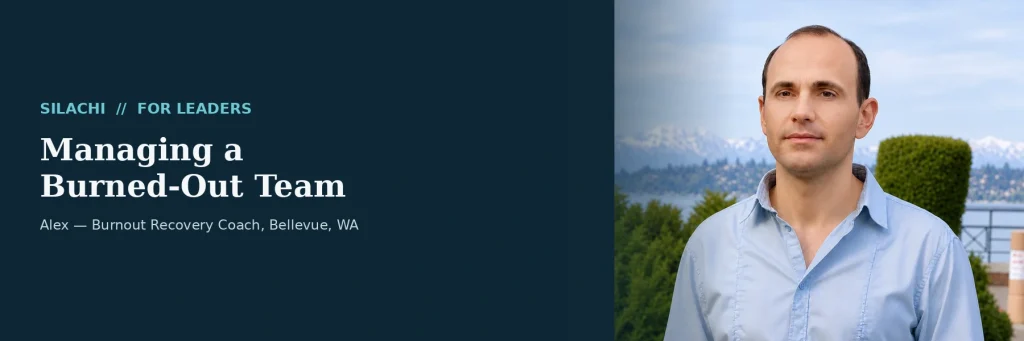
Managing a Burned-Out Team: A Leader’s Guide for Bellevue Tech Managers
Last updated: 08/2026 By Alex Akselrod, Certified Wellness Coach & Burnout Recovery Specialist
If you manage a team in Bellevue’s tech corridor, you’ve probably felt it before you could name it: a top performer who’s suddenly quieter in stand-ups, a normally reliable engineer missing small details, a direct report who says “I’m fine” in a tone that makes it clear they’re not. Managing your own burnout is hard enough — managing a team where burnout is spreading is a different challenge entirely, and most leadership training doesn’t prepare you for it.
This guide is written specifically for managers and team leads at Microsoft, Amazon, and other Bellevue-area tech employers who are trying to support a burned-out team while still meeting their own commitments to leadership above them.
Why This Is Harder Than It Looks
Supporting a burned-out team puts you in a genuinely difficult position, caught between several competing pressures at once:
- You’re accountable for output, even while some of that output is coming from people who are running on empty
- You may not have the authority to change the deadlines, headcount, or scope decisions that are actually driving the burnout
- Your own bandwidth is limited — you’re likely managing your own stress while trying to hold space for your team’s
- Burnout often hides well, especially among high performers who’ve learned to mask exhaustion rather than risk looking like they can’t keep up
None of this means you’re doing something wrong if your team is struggling. It means the problem is structural as much as it is personal, and your role is different from an individual contributor’s — you’re managing the system, not just your own energy.
Spotting Burnout in People Who Are Good at Hiding It
Some signs are obvious — visible fatigue, missed deadlines, irritability. But the people most at risk of burning out silently are often your strongest performers, who’ve built an identity around being reliable and don’t want to be the one who “can’t handle it.” Watch for subtler patterns:
- A previously proactive team member who’s become quiet in meetings, contributing only when directly asked
- Someone who used to catch edge cases or ask sharp questions, now turning in technically correct but noticeably less thoughtful work
- A team member who’s stopped pushing back or offering opinions, even on decisions they’d normally have strong views on
- Increasing cynicism in how someone talks about the work, the team, or the company — even in casual conversation
- A high performer suddenly asking about PTO policy, benefits, or “how flexible” the team can be, without a clear stated reason
These are quieter signals than someone visibly struggling, and they’re the ones most managers miss until the person is already deep into disengagement — or has quietly started interviewing elsewhere.
Having the Conversation Without It Feeling Like a Performance Review
One of the hardest parts of this is initiating a conversation that doesn’t feel like scrutiny. A few things that tend to help:
Lead with observation, not diagnosis. Instead of “I think you’re burned out,” try “I’ve noticed you’ve been quieter in our last few syncs — how are you doing, really?” This leaves room for them to define their own experience rather than accepting or rejecting a label you’ve assigned them.
Make it genuinely safe to say things are hard. If your team has learned that admitting struggle leads to being seen as less capable, they won’t tell you the truth no matter how the conversation is framed. This safety has to be built over time, not just invoked in a single 1:1.
Separate the conversation from any performance documentation. If your organization requires you to document performance conversations, be transparent about that upfront rather than having a “casual” check-in that turns out to have consequences your report didn’t expect.
Ask what would actually help, rather than assuming. Sometimes it’s workload. Sometimes it’s a difficult team dynamic. Sometimes it’s something entirely outside of work. Don’t assume you already know the answer.
What You Can Actually Control (Even Without Full Authority)
Many managers feel stuck because they don’t control headcount, deadlines, or org-wide culture. But there’s usually more within your control than it feels like in the moment:
- How you translate pressure from above. You can absorb some of the urgency from leadership rather than passing all of it downstream at full intensity.
- How meetings are structured. Cutting one recurring meeting, protecting focus blocks, or shifting a sync to async updates are small changes that meaningfully reduce cognitive load.
- How you talk about workload tradeoffs with your own leadership. Advocating for realistic scope, even if you don’t always win the argument, signals to your team that you’re on their side.
- How recognition and normalcy show up day to day. Publicly acknowledging good work, and being honest yourself about workload pressure, reduces the shame that often keeps people from asking for help.
When to Suggest Outside Support
If you’ve had the conversation and it’s clear someone is dealing with more than a rough sprint, it’s reasonable to point them toward resources — while being careful not to overstep into territory that isn’t yours as a manager:
- Your company’s Employee Assistance Program (EAP), if available, is a reasonable first mention for short-term support
- If burnout coaching comes up as an option, framing it as something available rather than something you’re prescribing keeps the conversation appropriate — something like, “Some people I know have found working with a burnout recovery coach helpful for exactly this kind of thing, if that’s something you’d want to look into.”
- Avoid diagnosing, avoid insisting, and avoid follow-up pressure about whether they’ve pursued it — the goal is to make support visible and available, not mandatory.
When Part of the Problem Is You
This is worth sitting with honestly: sometimes a manager’s own decisions — unrealistic timelines passed along without pushback, unclear priorities, inconsistent feedback — are part of what’s driving a team’s burnout. This isn’t a moral failing; most managers are themselves under pressure from above and doing their best with limited authority. But acknowledging this possibility, even just internally, often changes what kind of support actually helps: sometimes what a struggling team needs most isn’t a wellness resource, but a manager willing to say “I got this wrong, and I’m going to try to do better.”
Frequently Asked Questions
Can I require a team member to seek burnout coaching or counseling? No. You can make resources visible and available, but requiring someone to pursue specific support crosses into territory that isn’t appropriate for a manager and could raise real concerns depending on your company’s policies. The decision needs to stay with the individual.
What if my team’s burnout is caused by decisions from leadership above me that I can’t change? This is extremely common, and part of the job in that situation is being transparent with your team about what is and isn’t within your control, rather than pretending you have more influence than you do. Teams generally respond better to honest acknowledgment of constraints than to false reassurance.
Should I bring up burnout in a group setting or always 1:1? Individual conversations are almost always better for this. Group settings can pressure people to perform wellness rather than be honest, and what’s true for one person on the team may not be true for another.
Is it appropriate for me, as a manager, to also seek coaching for myself? Yes — and often it’s one of the more effective things a manager can do. Executive coaching specifically addresses the challenge of managing your own stress while also supporting a team, which is a distinct skill set from individual burnout recovery.
How do I know if this is burnout versus someone who’s simply not a good fit for the role? This distinction matters and isn’t always obvious. Burnout typically shows a change over time — someone who used to perform well and has gradually declined — whereas a fit issue tends to show up as a more consistent pattern from the start. If you’re unsure, it’s worth exploring directly with the person rather than assuming either explanation.
Support for Leaders, Not Just Individual Contributors
Managing a team through burnout while navigating your own pressures is genuinely difficult work, and it’s rarely covered in standard leadership training. If you’re looking for support in developing this specific skill set — leading through team burnout while sustaining your own performance — executive coaching at Silachi is built around exactly this kind of challenge.
Learn more about Alex Akselrod’s approach, explore coaching services, or schedule a free consultation to talk through what your team is facing. You can also reach out through the contact page with any questions.
Further reading: American Psychological Association – Coping with Stress at Work | World Health Organization – Burn-out an “occupational phenomenon”
About the Author
Alex Akselrod, Certified Wellness Coach and Burnout Recovery Specialist

Alex Akselrod is the founder of Silachi and a certified wellness and life coach based in Bellevue, WA, with 15 years of experience helping clients overcome burnout, chronic stress, and low energy using the integrative Silachi Method. A Qigong teacher, Advanced ThetaHealer®, and published author. Alex has worked with hundreds of high-performing tech professionals — including many at Microsoft — to help them rebuild sustainable, energized careers.